


Castillo de Mula
Castillo de Mula
Technology
Virtual Reality
Sector
Tourism
3D reconstruction of Mula Castle: virtual reality for the Renaissance fortress
The dissemination of medieval and Renaissance historical heritage requires advanced technological tools capable of capturing the imagination of today’s public. In this context, Natoural Digital Solutions has developed a 3D reconstruction project of Mula Castle, also known as the Castillo de los Vélez, a fortress built between 1520 and 1531 on the remains of an earlier Andalusi alcazaba, which can be viewed with virtual reality headsets.
1. A digital reconstruction based on historical documentation
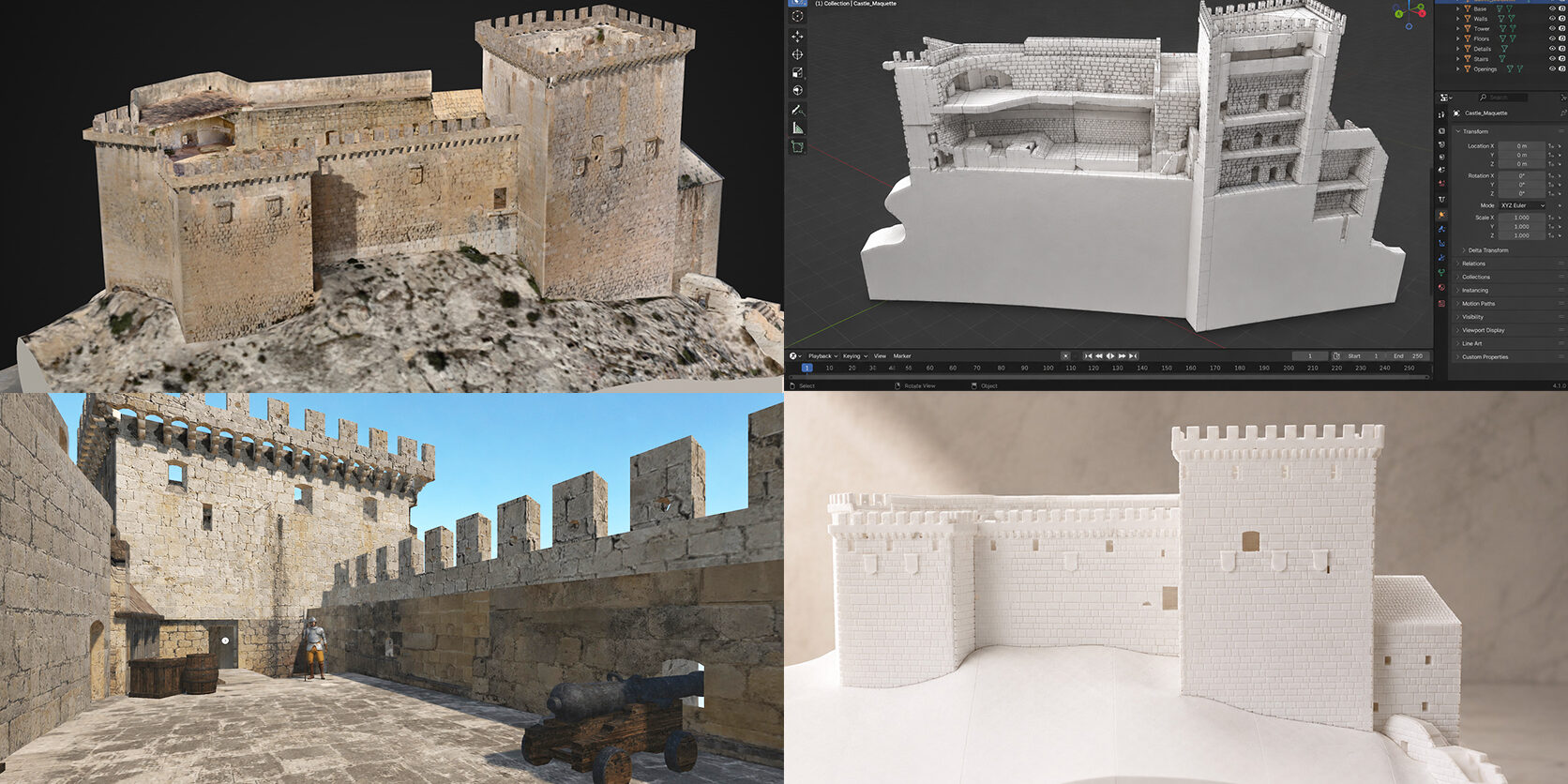
The first strand of the project is the volumetric reconstruction of the castle, developed in collaboration with local archaeologists and historians and based on the survey drawings and the surviving historical documentation. The following have been modelled:
- The keep, the defensive and residential core of the fortress.
- The earlier Islamic rammed-earth wall, predating the Renaissance castle, next to the adjoining tower-cistern.
- The parade ground and the interior rooms of the fortified enclosure.
To give the reconstruction historical rigour, photorealistic textures of sandstone, weathered woods and dynamic natural lighting effects have been incorporated, reflecting the architectural development of the monument from the 9th-century Islamic alcazaba to the Renaissance fortress of the Marquises of Los Vélez.
2. 3D-printed physical model adapted for people with visual impairments (tactile Braille model)
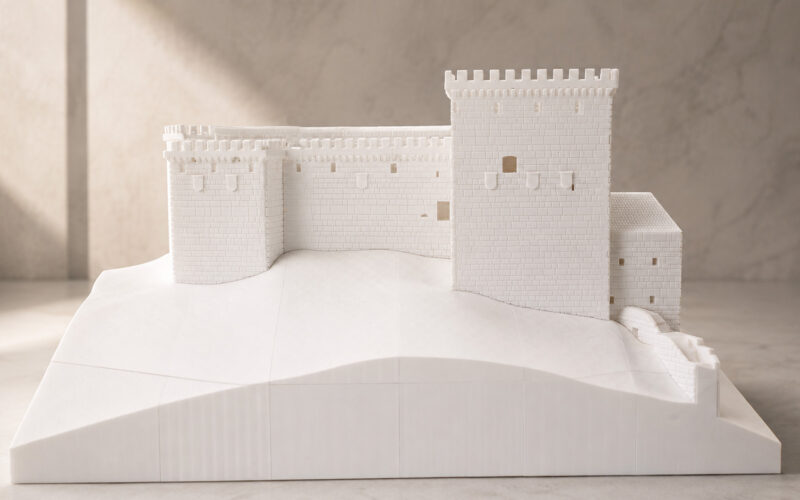
Another strand of the project is the 3D-printed physical model of Mula Castle, made in high-precision plastic, with a high level of architectural detail and fully adapted for people with visual impairments through Braille text and labelling.
The model:
- It reproduces, in a way that is accessible by touch, the overall volume of Mula Castle, its architectural layout and its main defensive elements.
- It makes it easier to understand the spatial layout of the monument through a three-dimensional representation that can be explored both visually and by touch.
- It serves as an inclusive resource for guided visits, educational activities and heritage outreach open to everyone.
In this way, the model widens the possibilities for interpreting Mula Castle and makes it possible to bring its architecture and historical development closer to visitors with different abilities, supporting a more inclusive and accessible heritage experience.
3. Immersive exploration with virtual reality headsets
The second strand is a virtual reality experience for Meta Quest, available under the name “Castillo de Mula” in the app store, optimised for smooth navigation without motion sickness. The application allows you to:
- Stand virtually on the keep and walk the perimeter of the medieval wall.
- Appreciate clearly how the castle’s architecture evolved over the centuries.
- Explore the site in an immersive environment that combines the digital model with the real landscape around the town.
This experience is of particular value because, at present, Mula Castle is not regularly open to the public, after decades of litigation over its ownership that the City Council has recently succeeded in resolving.
4. Technological innovation in the service of cultural tourism
The third strand is the integration of virtual information points within the three-dimensional environment itself, taking the traditional guided-visit model a step further. The technological development phases completed include:
- Structural architectural modelling: a three-dimensional recreation of the bastions, walls and interior rooms.
- VR performance optimisation: adapting dynamic textures to ensure smooth navigation.
- Integration of photographic environments: fusion of the digital model with the real geographical landscape of the hill and the city of Mula.
Immersive technology in the service of Renaissance heritage
With this project, Natoural Digital Solutions applies to Mula Castle the same line of work developed at other sites in the region: 3D modelling makes it possible to reconstruct with fidelity a fortress that sums up eight hundred years of history, from the Andalusi alcazaba to the Renaissance power of the Marquises of Los Vélez, while virtual reality on Meta Quest brings that past closer to an audience that cannot usually access the monument today.