


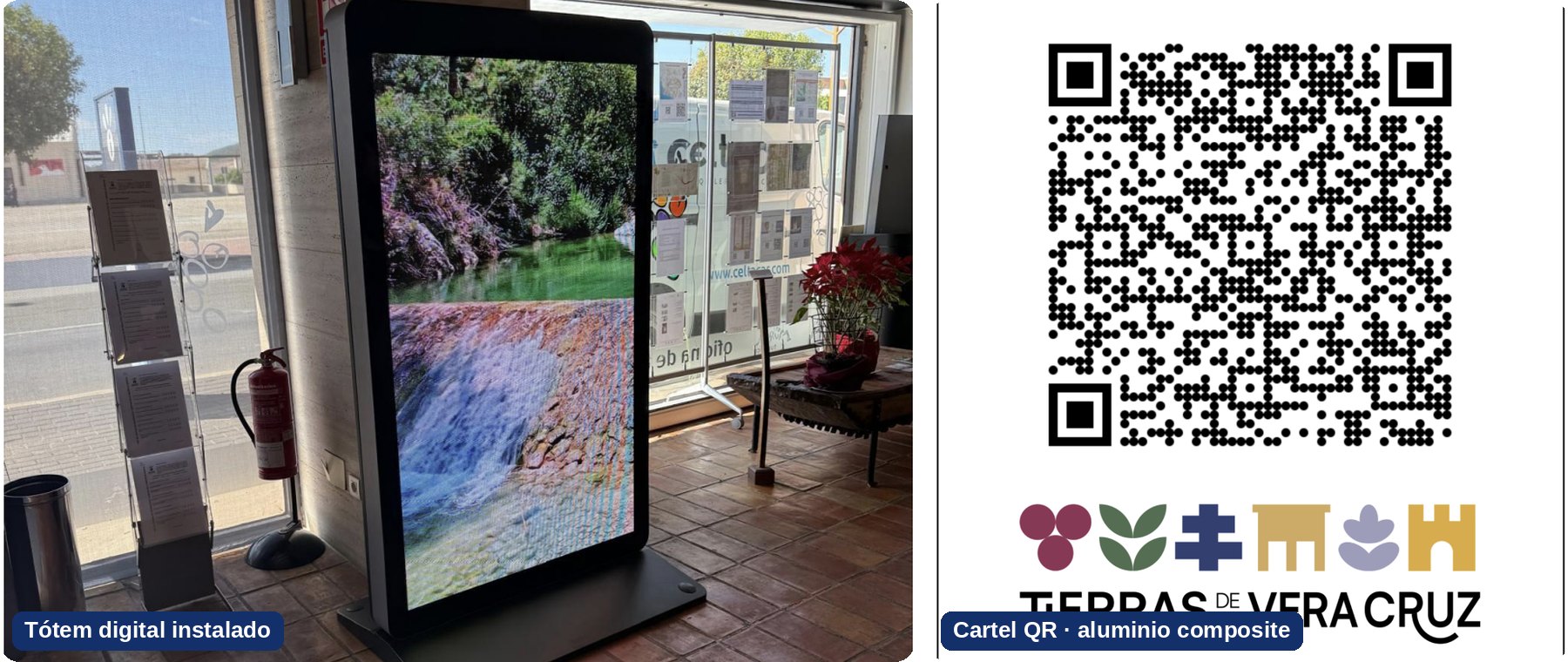
Digital totems are used to inform people in the very place of the visit. They do not, however, replace the municipal website or the tourist office. They are a support in the street, in a square or beside a monument. At Natoural DS we bring more than 15 years of experience in new technologies. We offer signage plans with QR posters and digital totems. We also design the content, propose the location and integrate it with QR codes, an app and augmented reality.
What digital totems bring
A digital totem concentrates useful information in a visible, recognisable place. Residents or visitors therefore do not have to guess where to go. They can consult tourism, events, public notices and accessibility resources. They can also open a QR code and continue on their own phone. Turespaña promotes tourism in Spain. Many city councils are therefore looking for clear information points in the destination. Digital totems meet that need in the public street. Below we explain how we approach this service. Then, a real case already delivered.
A signage and location plan
First, we study the real routes taken by residents and visitors. We then propose where a totem, a QR poster or another support makes sense. It is not a matter of filling the public street with screens. Instead, a few heavily used points are chosen. For example, a monumental setting, a square or an entrance to the historic centre. Also a visitor reception centre. The signage plan also coordinates messages, languages and graphic design. In this way, the information is recognisable throughout the municipality. The city council decides the locations. We help to organise them and to define what each point should say.
Tourism, events, public notices and accessibility
The value of digital totems lies in the story and in their usefulness, not only in the piece of furniture. In particular, a city council can provide information on how to reach a monument or a museum. It can also show the events calendar and municipal notices. A change of opening hours, a closed street or a festival can all fit that channel. Accessibility forms part of the commission. For example, clear texts, easy reading and guidance for different audiences. The content can also be offered in several languages when the destination asks for it. We design that information layer to fit each municipality.
A real case: the digital totems of Tierras de la Vera Cruz
In the Tierras de la Vera Cruz destination we installed eight outdoor digital totems. The commission came from the Mancomunidad de Servicios Turísticos del Noroeste, based in Calasparra. The destination is made up of Bullas, Calasparra, Caravaca de la Cruz, Cehegín, Moratalla and Mula. The totems were installed in these municipalities. We also designed the project’s physical signage, with a QR code to download the app. Each poster and each totem invites people to download the application. It also invites them to experience what each municipality has to offer. The posters in Bullas, Calasparra and Mula point to the virtual reality experience. The one in Caravaca points to the immersive room. Those in Cehegín and Moratalla lead to the augmented reality in the app. The same plan includes smart, accessible signage, with lecterns, captions and Wi-Fi points. The Tierras de la Vera Cruz app brings the six municipalities together. It offers geolocated maps, an events calendar and local gastronomy.
QR codes, an app and augmented reality, connected to the totem
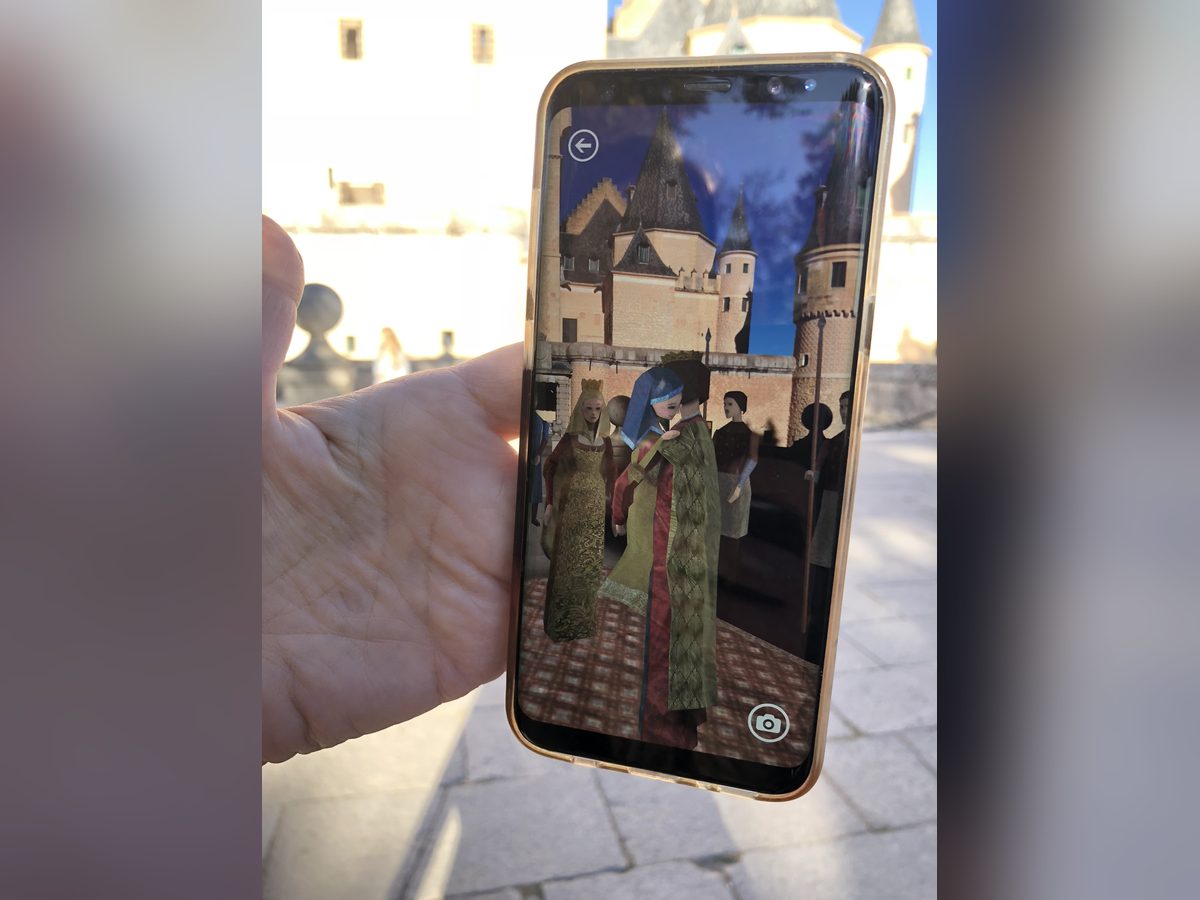
A totem does not have to contain everything on its own screen. It can display a QR code that opens an experience on the phone. There is no need to install an application at that moment. At the Cathedral of San Salvador in Oviedo we have already delivered content of this kind. The Gothic Tower augmented reality experience opens by scanning a QR code. It combines 360° reconstructions, 3D animation, narration and surround sound. The City Council promoted it as part of the “Oviedo, Origen del Camino” plan. The same kind of access can live on a QR poster or on a digital totem.
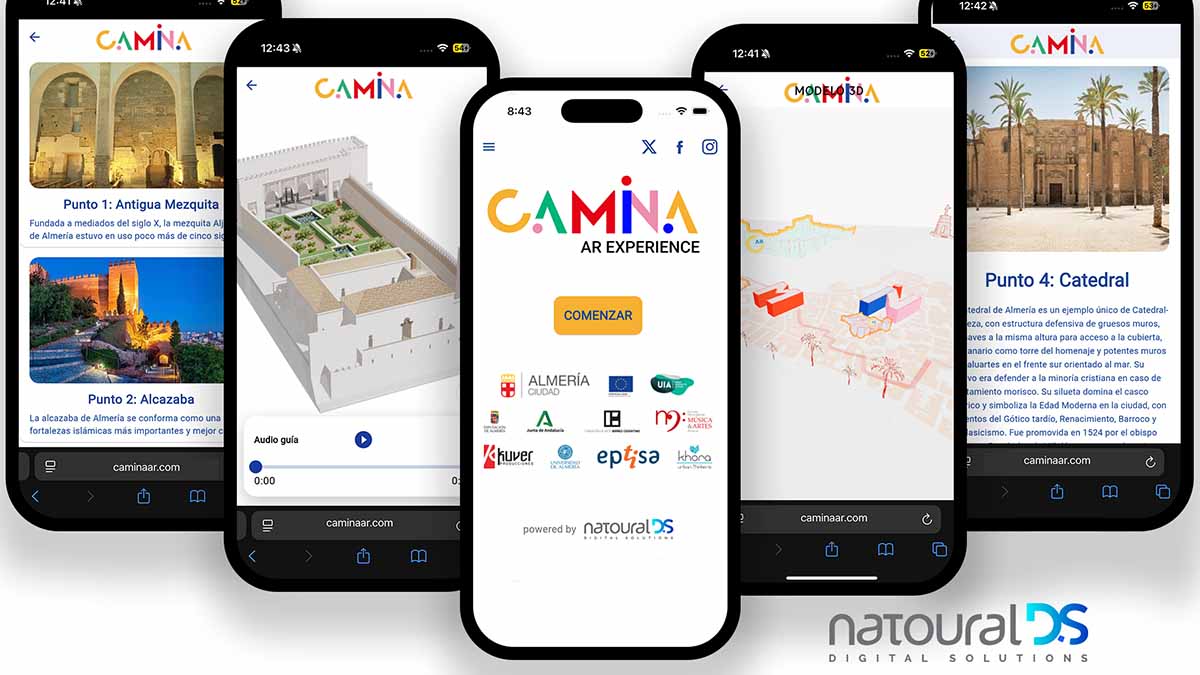
A QR code is not the only route, however. For Almería City Council we developed Almería Camina AR. It is an augmented reality website with 3D reconstructions of monuments. It works in the browser, with no app to download. A totem can therefore point to that page and the visitor continues on their phone. Access is immediate and does not depend on an app store.
We have also delivered destination information in other applications. Mazarrón Virtual guides visitors through three sites on the bay. It includes the Phoenician Ship Museum, the Roman salting factory and the former Alumbres works. Ciudad Rodrigo AR Experience was commissioned by Ciudad Rodrigo City Council. It provides information about the Peninsular War on the real sites. Digital totems can link to those resources. They give them a visible point of presence in the street.
In a building, a touchscreen allows a more unhurried consultation. At the Alquería de Villa Vieja we adapted the interactive environment for touchscreens. It is intended for the Villa Vieja Interpretation Centre. Also for the Museo Arqueológico La Encomienda. That shared-consultation approach works in a reception space. The signage plan can therefore combine totems in the street and screens in a building.
How the content is kept up to date
An out-of-date totem gives poor information. The service therefore includes the maintenance of the content. The events calendar, notices, opening hours or a route can be renewed. Paper posters that become obsolete the day after a festival are also avoided. The city council needs a simple procedure for updating. We take that into account from the design stage. In this way, the digital totems remain useful after the inauguration. The support does not end with the presentation event.
How to commission a digital totem project
If you work in a city council or a tourism department, you can start gradually. You do not need to cover the whole city at once. You can start with a well-defined point and story. The signage plan can then be extended to more locations. Digital totems work better when the message is clear and can be kept up to date. On the Augmented Reality page we explain how the experiences that a QR code can open are built. Tell us the place, the audience and the information you want to convey. Tell us about your project on the Contact page.

